



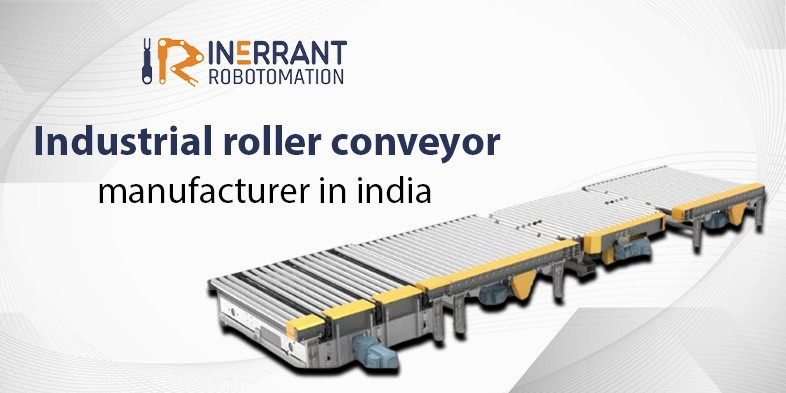
In modern manufacturing and material-handling operations, efficient movement of products, components, cartons, pallets, and assemblies is essential for maintaining productivity.Industrial roller conveyors provide a reliable way to move materials between production, assembly, packaging, inspection, warehousing, and dispatch areas.
Designs and manufactures industrial roller conveyor solutions for applications requiring smooth material flow, durable construction, automation integration, and customized layouts. Its roller conveyors are designed for production lines, packaging areas, warehouses, and automated assembly systems.
An industrial roller conveyor is a material-handling system that uses a series of rollers to transport products or loads from one location to another.
Depending on the application, roller conveyors can be designed as:
The appropriate configuration depends on load weight, product dimensions, conveyor length, and required speed, layout, and automation requirements.
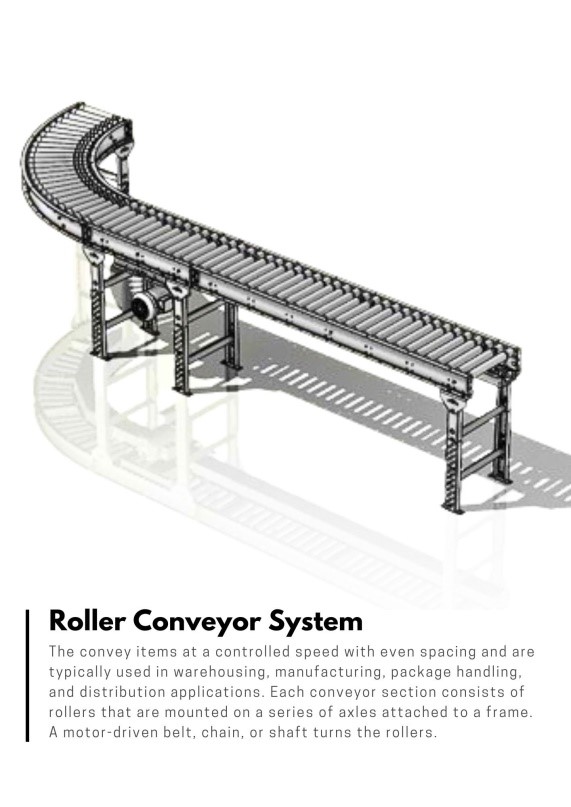
Material is placed on a series of rollers positioned along the conveyor frame. The rollers support the load and allow it to move along the desired path.
In a gravity roller conveyor, the product moves using gravity or manual pushing.
In a powered roller conveyor, motors and drive mechanisms rotate the rollers to provide controlled and continuous movement.
Sensors, PLCs, robotic systems, and other automation components can also be integrated where automated material handling is required. Inerrant states that its roller conveyors are compatible with sensors, robotic systems, and PLC-based automation.
This enables manufacturers to develop more connected material-handling processes.
5.Low Maintenance A suitable conveyor design combined with appropriate maintenance can help minimize wear and support long-term operation. 6.Energy-Efficient Operation Powered systems can be engineered according to the required load and movement conditions to avoid unnecessary energy consumption.Roller conveyors are used across many industries for transporting materials and products.
Applications include:
Roller conveyors can help move:
They can also support sorting and dispatch operations.
Roller conveyor systems can be used for:
They can provide controlled movement of components and assemblies between production and inspection stations.
Appropriately designed conveyor systems can support material movement where hygiene and efficient product handling are important.
Roller conveyors can be incorporated into material-handling processes according to the product, environment, and applicable operational requirements.
Inerrant lists automotive and engineering, food and beverage, packaging and logistics, electronics manufacturing, pharmaceutical and chemical, and warehousing and e-commerce among the industries it serves.
Automated or semi-automated material movement reduces unnecessary manual transportation and can improve production flow.
Roller conveyors help move materials between workstations without requiring operators to manually carry every item.
A properly designed conveyor system provides predictable movement between production stages.
Reducing repetitive manual material handling can help create a safer and more organized production environment.
Custom conveyor layouts can be designed around available factory or warehouse space.
Roller conveyors can be incorporated into larger automation systems as production requirements grow.
These benefits align with Inerrant's stated objectives of improving productivity, material flow, safety, automation, and scalability.
When selecting an industrial roller conveyor, consider:
| Parameter | Selection Consideration |
|---|---|
| Conveyor Type | Gravity / Powered |
| Conveyor Length | Based on plant layout |
| Conveyor Width | Based on product dimensions |
| Roller Diameter | Based on load and product |
| Roller Pitch | Based on product size and stability |
| Load Capacity | Maximum product or pallet weight |
| Conveyor Speed | Required material-transfer speed |
| Drive System | Motorized or gravity |
| Frame Material | Application-specific |
| Roller Material | MS / SS / application-specific |
| Control System | Manual / PLC / automated |
| Sensors | Optional automation integration |
| Safety Features | Guards, emergency stops, sensors |
| Installation | Floor, elevated, or customized |
Note:Actual specifications should be finalized according to the load, product dimensions, speed, operating environment, and automation requirements.
For high-volume manufacturing, this integration can improve consistency and reduce manual intervention.
Before purchasing a roller conveyor, manufacturers should evaluate:
Determine the maximum weight of the product, carton, container, or pallet.
2.Product DimensionsThe conveyor width and roller spacing should be suitable for the products being transported.
3.Required SpeedDefine the required material-transfer speed and production cycle.
4.Conveyor LayoutConsider straight sections, curves, transfers, elevation changes, and available floor space.
5.Manual or Automated OperationDecide whether gravity movement is sufficient or whether powered movement and automation are required.
6.Operating EnvironmentConsider dust, moisture, temperature, chemicals, hygiene requirements, and other environmental conditions.
7.Future ExpansionChoose a modular and scalable design if the production line may expand.
Provides customized industrial conveyor and automation solutions. The company states that it supports conveyor design, manufacturing, installation, and maintenance, with solutions tailored to plant layout, load requirements, and automation objectives.
Key advantages include:
The company also describes its broader automation capabilities as including conveyors, robotics, vision systems, PLCs, AGVs, AMRs, and automated assembly solutions.
Working with an experienced Indian manufacturer can provide industrial buyers with:
For OEMs and manufacturers, selecting a supplier based on engineering capability, quality, customization, service, and total lifecycle value is more important than comparing purchase price alone.
An industrial roller conveyor can significantly improve material handling by providing smooth, controlled, and repeatable movement of products, components, cartons, and pallets.
For manufacturing, automotive, packaging, logistics, warehousing, electronics, food, pharmaceutical, and other industrial applications, the right conveyor can reduce manual handling, improve workflow, support automation, and increase operational efficiency.
Inerrant Robotomation Pvt. Ltd. offers customized roller conveyor solutions designed around specific load, layout, speed, product, and automation requirements.
Looking for an Industrial Roller Conveyor Manufacturer in India?
Contact Inerrant Robotomation Pvt. Ltd. for customized roller conveyor and industrial automation solutions tailored to your production and material-handling requirements.