



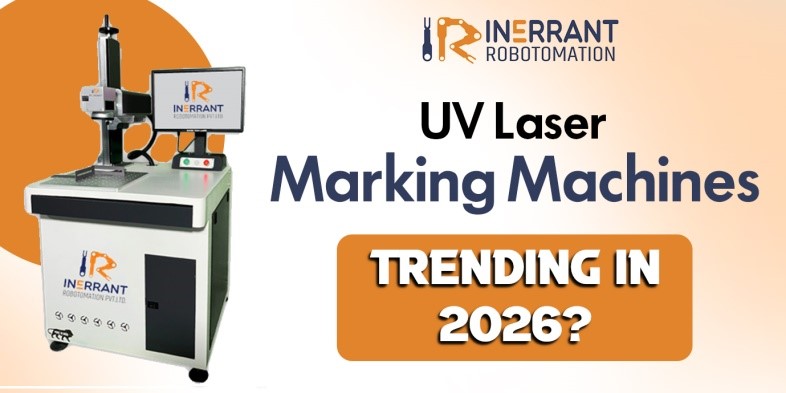
As the era of precision and green manufacturing dawns on the world of industrial manufacturing, one technology has emerged as the undisputed game-changer: the UV Laser Marking Machine. Although traditional fiber and CO_2 lasers have their niche markets, 2026 represents a paradigm shift towards UV laser technology. This is because the world is witnessing the advent of miniaturization in the field of electronics, the medical industry is becoming increasingly stringent, and the world is moving towards "green" manufacturing processes.
For factory owners and production managers, the use of UV laser technology is no longer an upgrade but a paradigm shift. Obtaining the latest marking systems from industry leaders such as Inerrant will ensure that the most sensitive materials are marked without any thermal damage, keeping production lines efficient and products of high quality in the increasingly demanding market.
A UV laser marking machine has a short wavelength of 355 nm, enabling it to carry out a process called “cold marking.” In contrast to infrared lasers, which use heat to melt or burn a material, UV lasers use high-energy photons to break down the molecular structure of a material. Their application in 2026 is:
In 2026, "good enough" marking is a hindrance. The worldwide trend of UV lasers is driven by the need for permanent and high-contrast identification that satisfies the requirements of the new age.
In the electronics industry and the medical industry, heat is the nemesis. A UV laser marking machine creates a "thermal firewall" that releases energy at such a rapid pace and with such accuracy that the surrounding material does not have time to heat up.
The regulations for "Unique Device Identification" in the medical sector and "Part Traceability" in the automotive sector have become more stringent worldwide. UV lasers ensure the contrast necessary for high-density 2D barcodes that remain readable after sterilization, chemical resistance, and heavy usage over the years. This reduces the chances of non-compliance and product recalls.
Sustainability is the driving force behind the trends of 2026 in the industrial sector. The UV laser marking process is completely sustainable since it does not require ink, solvents, or chemicals. This "zero-consumable" process reduces a manufacturing facility's carbon emissions and hazardous waste generation substantially, meeting global green manufacturing requirements.
Conventional inkjet printers need continuous cleaning and frequent refilling. In contrast, the UV laser printer from Inerrant is almost maintenance-free. There are no nozzles to clog and no mechanical parts to fail, resulting in a substantial cut in operational expenses and a rapid Return on Investment (ROI) for businesses.
At Inerrant, we design our UV laser marking systems to go beyond the tough requirements of Industry 4.0:
The ultra-fine "cold" laser beam of UV lasers is a must-have for:
Inerrant is a pioneer in laser innovation and aims to deliver the level of precision your brand requires through:
The emergence of the UV Laser Marking Machine in 2026 marks the beginning of a brighter, smarter, and more precise manufacturing era. Whether you are dealing with heat-sensitive medical products or premium electronics, the "cold marking" feature of UV Laser Technology gives you the quality that conventional lasers just cannot deliver. For a superior line of UV laser systems that promise precision and sustainability, Inerrant is your worldwide partner.
Fiber lasers (1064 nm) rely on heat to engrave metals and tough plastics. UV lasers (355 nm) employ "cold marking" to disrupt chemical bonds, which makes them much safer for glass, wood, and fragile plastics.
Yes, UV lasers can successfully mark most metals. They are best suited for producing high-contrast images on coated or highly reflective metals that are difficult for fiber lasers to process.
Most high-quality UV laser sources are designed to last about 20,000 hours. With good environmental control and regular optical cleaning, the life of the source can be extended.
Yes. It is one of the safest and cleanest methods for marking food and pharmaceutical packaging because it doesn't use any inks or chemicals or create debris.
It is referred to as “cold marking” because the ultraviolet light used in this process has high energy, which directly breaks the molecular bonds without using the heat energy to melt the material.