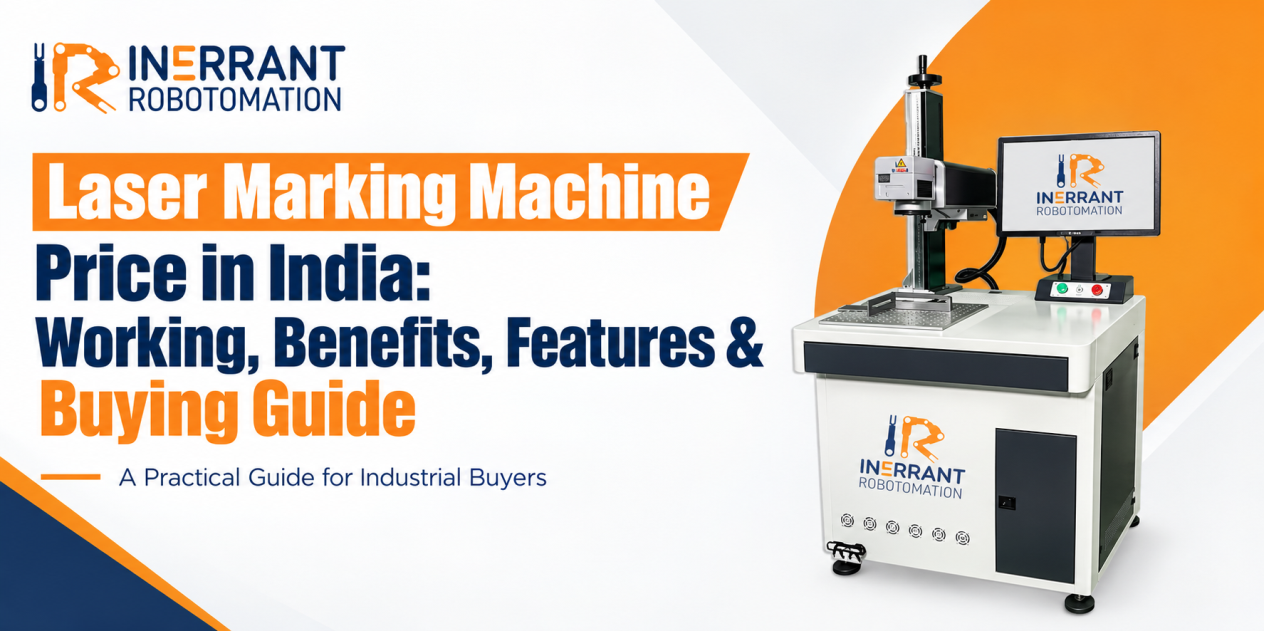
A laser marking machine is an industrial marking system that uses a focused laser beam to create permanent text, numbers, logos, barcodes, QR codes, serial numbers, symbols, and graphics on the surface of different materials. In India, laser marking technology is widely used by manufacturers that require high-precision, permanent, fast, and traceable product identification.
Instead of using ink, labels, engraving tools, or mechanical contact, a laser marking machine creates marks by precisely controlling the laser beam according to a digital design. This makes the technology suitable for high-volume manufacturing as well as applications where accuracy, consistency, and long-lasting identification are important.
What Is a Laser Marking Machine?
A laser marking machine is a computer-controlled industrial marking system designed to permanently mark or engrave information onto a component or product. Depending on the laser technology and material, the machine can produce marks through processes such as annealing, engraving, ablation, foaming, carbonization, or color change.
The marking process can be programmed using dedicated software, allowing manufacturers to change the marking content without changing physical tools. This is particularly useful for production environments where products require different model numbers, batch codes, serial numbers, dates, QR codes, or customer-specific information.
Laser marking can be performed on materials such as stainless steel, mild steel, aluminum, copper, brass, plastics, engineering polymers, coated metals, electronic components, and various industrial materials, depending on the laser source selected.
How Does a Laser Marking Machine Work?
The working principle of a laser marking machine involves generating, directing, focusing, and controlling a laser beam over the surface of a workpiece.
First, the machine generates a laser beam using a suitable laser source. Common industrial laser sources include fiber, CO₂, and UV lasers, with the appropriate type selected according to the material and marking requirement.
The laser beam is then directed through an optical system and scanning mechanism. Galvanometer scanners rapidly move the focused beam across the required marking area.
The operator creates or imports the required design through the marking software. This may include text, numbers, logos, barcodes, QR codes, graphics, serial numbers, or variable production data.
When the focused laser beam reaches the material surface, its energy interacts with the material. Depending on the application, the laser may remove a very small amount of material, change its color, alter its surface structure, or create a controlled engraving.
The result is a highly precise and permanent mark. Because the marking parameters are digitally controlled, the same design can be reproduced consistently across large numbers of components.
Why Use a Laser Marking Machine?
Manufacturers use laser marking machines primarily when they need permanent identification, high marking accuracy, production traceability, and repeatable results.
Traditional marking methods may require consumables, physical tools, labels, or direct mechanical contact. Laser marking eliminates many of these requirements and provides a non-contact marking process.
For industries producing thousands or millions of components, laser marking can also become an important part of the manufacturing and traceability process. Each product can receive a unique serial number, QR code, barcode, batch number, or production date.
Laser marking is especially useful when the marking must remain readable throughout the product's service life or through processes such as cleaning, handling and industrial use.
Major Benefits of Laser Marking Machines
1. Permanent Marking: Laser markings are designed to remain on the product for a long period. Depending on the material and marking method, the identification can withstand handling, cleaning, abrasion, and environmental exposure. 2. High Precision: The focused laser beam allows extremely accurate marking of small characters, intricate graphics, fine lines, and machine-readable codes.
This makes laser marking suitable for components where conventional marking methods may not provide the required level of detail. 3. Fast Marking: Laser marking systems can mark products quickly, making them suitable for automated and high-volume manufacturing environments.
The marking speed depends on factors such as material, marking depth, design complexity, laser power, and required quality. 4. Non-Contact Process: The laser does not physically touch the component during marking. This reduces mechanical wear on marking tools and minimizes the risk of physical deformation caused by conventional contact-based marking methods. 5. Low Consumable Requirement: Unlike ink-based printing, laser marking generally does not require ink, cartridges, ribbons, or labels for the marking operation.
This can simplify production and reduce consumable-related maintenance. 6. Excellent Repeatability: Once suitable marking parameters have been established, the machine can reproduce the same marking pattern consistently across large production batches. 7. Digital and Flexible Operation: Marking content can be changed through software. Manufacturers can quickly modify serial numbers, product codes, logos, dates, or other information without changing physical tooling. 8. Supports Product Traceability: Laser marking can be used to apply unique identification information such as serial numbers, batch codes, barcodes, QR codes, and Data Matrix codes.
These markings can help manufacturers track products through production, inspection, inventory, distribution, and after-sales processes. 9. Suitable for Automation: Laser marking machines can be integrated with production lines, robotic systems, sensors, vision systems, conveyors, and manufacturing databases.
This allows marking to become part of an automated production process. 10. Consistent Professional Appearance: Laser marking provides clean and controlled identification, which is particularly important for branded products, industrial components, electrical equipment, automotive parts, and consumer products.
Key Features of a Laser Marking Machine
Modern laser marking machines can include a wide range of features depending on the machine configuration and industrial requirement.
• Fiber Laser Source: Fiber lasers are widely used for marking metals because they provide high-quality and precise marking on materials such as stainless steel, aluminum, brass, copper, and other metal components.
• High-Speed Galvanometer Scanning: A galvanometer scanning system rapidly moves the laser beam across the marking field, allowing fast creation of text, graphics, codes, and patterns.
• Computer-Controlled Marking Software: The software allows users to create, edit, store, and reproduce marking designs. It can support different fonts, graphics, serial numbering, barcodes, QR codes, and other variable information.
• Variable Data Marking: Manufacturers can automatically generate changing information such as:
• Serial numbers
• Batch numbers
• Manufacturing dates
• Product codes
• Shift information
• QR codes
• Barcodes
• Data Matrix codes
• High-Resolution Marking: Laser systems can produce small and detailed characters, making them suitable for components with limited marking space.
• Adjustable Marking Parameters: Operators can adjust parameters such as laser power, speed, frequency, pulse settings, and other process variables according to the material and required marking quality.
• Safety Enclosure: Industrial laser marking systems may be supplied with protective enclosures and safety interlocks to help control exposure to the laser during operation.
• Rotary Marking Capability: Rotary attachments can be used for marking cylindrical components such as shafts, tubes, rings, bearings, and other round parts.
• Automation Integration: Depending on the system, the machine can be integrated with conveyors, robots, PLC systems, sensors, barcode scanners, cameras, and production management systems.
• Vision Inspection: Some advanced systems can combine laser marking with machine vision so that the marked code or text can be automatically inspected after marking.
Types of Laser Marking Machines
Different laser sources are selected according to the material and application.
• Fiber Laser Marking Machine: Fiber laser marking machines are commonly used for metal marking applications. They are suitable for materials including stainless steel, aluminium, iron, mild steel, brass, copper, and many industrial metal components.
Typical applications include automotive components, machine parts, electrical components, tools, bearings, industrial equipment, and metal nameplates.
• CO₂ Laser Marking Machine: CO₂ lasers are commonly used for non-metallic materials such as certain plastics, wood, rubber, leather, glass, paper, packaging materials, and coated surfaces.
They are frequently used in packaging, consumer products, electronics, and non-metallic industrial applications.
• UV Laser Marking Machine: UV lasers use a shorter wavelength and are suitable for applications requiring controlled and fine marking with limited heat impact.
They can be used for sensitive plastics, electronic components, medical products, glass, and other materials where heat-affected areas need to be minimized.
Applications of Laser Marking Machines
Laser marking technology is used across a wide range of manufacturing industries because different products require permanent identification and traceability.
• Automotive Industry: Automotive manufacturers and component suppliers use laser marking for engine components, transmission parts, gears, shafts, bearings, brake components, electrical parts, sensors, and other vehicle components.
Serial numbers, part numbers, manufacturing information, QR codes, and traceability codes can be permanently marked on components.
• Engineering and Manufacturing Industry: Industrial engineering companies use laser marking to identify machine components, tools, fabricated parts, assemblies, and equipment.<
Permanent marking helps manufacturers maintain component identification throughout manufacturing and service operations.
• Electronics Industry: Laser marking is used on electronic components, connectors, switches, housings, circuit-related components, and other products where small, accurate identification is required.
Fine marking capabilities are particularly useful where available marking space is limited.
• Electrical Industry: Electrical manufacturers can use laser marking for switches, terminals, connectors, control components, electrical enclosures, meters, and other products.
Product identification, ratings, model numbers, logos, and traceability information can be marked directly onto components.
• Medical Device Industry: Medical and healthcare equipment manufacturers may use laser marking for identification and traceability of suitable medical components and instruments.
The marking process can provide durable identification without relying on labels that may detach during cleaning or handling.
• Aerospace Industry: Aerospace component manufacturers require reliable identification and traceability for many components.
Laser marking can be used for part numbers, serial numbers, identification codes, and other manufacturing information on suitable aerospace materials and components.
• Pharmaceutical Industry: Laser marking can support identification and traceability requirements for suitable pharmaceutical packaging and equipment components.
Depending on the application, laser systems can mark codes and identification information without conventional ink-based printing.
• Packaging Industry: Laser technology can be used for marking production information, dates, batch codes, barcodes, and other variable information on suitable packaging materials.
• Jewellery Industry: Fine laser marking can be used for jewellery identification, branding, serial numbers, logos, and intricate designs.
The precision of laser technology makes it suitable for small and detailed markings.
• Tool and Hardware Industry: Manufacturers of cutting tools, hand tools, machine tools, fasteners, and hardware products can use laser marking for brand names, model numbers, sizes, specifications, and identification codes.
• Bearing Industry: Laser marking is useful for marking bearing numbers, batch identification, manufacturer information, logos, and traceability codes on suitable bearing components.
• Renewable Energy Industry: Solar, wind-energy, and other renewable-energy equipment manufacturers can use laser marking for component identification, serial numbers, manufacturing information, and traceability.
• Industrial Automation and Robotics: Robotic and automation equipment manufacturers can use laser marking to identify motors, gearboxes, robotic components, sensors, brackets, mechanical parts, and electrical components.
Laser Marking for Product Traceability
One of the most important applications of laser marking is industrial traceability.
A manufacturer can assign a unique identification code to each component. This code can contain information such as product type, manufacturing batch, production date, serial number, or other relevant information.
A QR code or Data Matrix code can then be scanned at different stages of the production and supply chain.
This creates a connection between the physical component and its digital production record.
For example, an automotive component can receive a unique Data Matrix code during manufacturing. The code can subsequently be scanned during inspection, assembly, inventory management, and service operations.
This approach helps manufacturers organize production data and improve product identification.
Laser Marking vs Traditional Marking Methods
Traditional methods such as stamping, engraving, screen printing, inkjet printing, and labels each have their own applications. However, laser marking provides several advantages when permanent, precise, non-contact identification is required.
Laser marking does not require a physical engraving tool to contact the product, and the marking design can be changed digitally.
It can also reduce dependence on consumables such as inks, labels, and ribbons, depending on the application.
For high-volume manufacturing, the ability to automatically generate and mark variable information is another significant advantage.
Factors to Consider When Selecting a Laser Marking Machine
Selecting a laser marking system should be based on the actual production requirement rather than only the machine specification.
Important considerations include:
• Material being marked
• Required marking depth
• Required marking speed
• Marking area
• Character size
• Required resolution
• Production volume
• Type of identification code
• Automation requirements
• Component size and shape
• Required traceability
• Available workspace
• Safety requirements
• Required software functions
• Future production requirements
The laser source should be selected according to the material and the type of mark required. A system suitable for stainless steel may not necessarily provide the same results on plastic, glass, or coated materials.
Why Laser Marking Is Important for Modern Manufacturing
Modern manufacturing increasingly depends on automation, traceability, quality control, and digital production records.
Laser marking supports these requirements by allowing manufacturers to place machine-readable information directly onto products.
Unlike a removable label, a properly selected laser mark becomes part of the product surface. This makes it useful for applications where product identification needs to remain available throughout manufacturing, distribution, installation, and service.
The ability to integrate laser marking with automated production systems also allows manufacturers to reduce manual marking operations and improve consistency.
Why do manufacturers use laser marking?
Manufacturers use laser marking when they require permanent identification, high precision, repeatability, fast processing, product traceability, digital control, and compatibility with automated manufacturing systems.
Conclusion
A laser marking machine in India is an important industrial technology for manufacturers that require accurate, permanent, and digitally controlled product identification. Its ability to mark metals, plastics, and other suitable materials makes it applicable across a wide range of industries.
From serial numbers and product codes to QR codes, logos, batch information, and traceability data, laser marking provides manufacturers with a flexible way to identify products throughout their lifecycle.
The combination of high precision, non-contact operation, repeatability, low consumable requirements, fast processing, software control, and automation compatibility makes laser marking particularly valuable for modern manufacturing environments.
Discover the best prices for Laser Marking Machines at Inerrant Robotomation Pvt. Ltd. High precision, efficiency, and customizable solutions for all industries.
FAQ
A laser marking machine is used to create permanent identification such as text, serial numbers, logos, barcodes, QR codes, Data Matrix codes, batch numbers, and graphics on suitable materials.
Yes. Fiber laser marking systems are widely used for marking metals such as stainless steel, aluminium, iron, mild steel, brass, copper, and other industrial metal components.
Laser marking can create highly durable and permanent identification when the correct laser type and marking process are selected for the material and application.
Most laser marking processes do not require ink, ribbons, or printing cartridges because the laser creates the mark directly on the material surface.
Yes. Laser marking machines can create QR codes, Data Matrix codes, barcodes, serial numbers, and other machine-readable identification formats.
Yes. Laser marking systems can be integrated with PLCs, conveyors, robots, sensors, cameras, barcode systems, and manufacturing databases for automated production.
Laser marking is used across automotive, engineering, electronics, electrical, medical devices, aerospace, pharmaceuticals, packaging, jewellery, tools, bearings, renewable energy, robotics, and industrial manufacturing.