



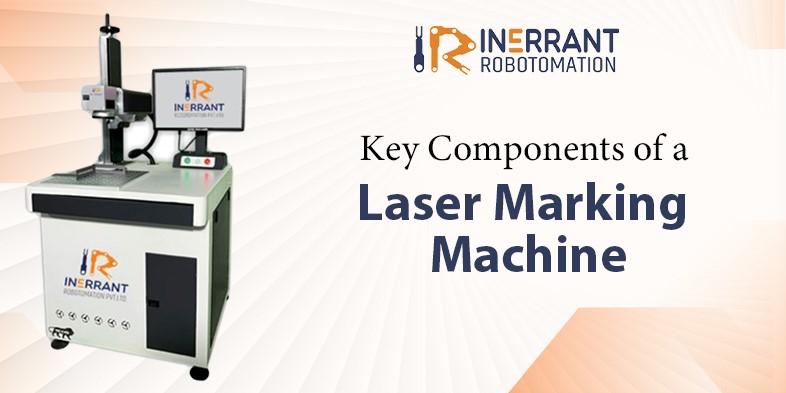
A laser marking machine is one of the most advanced industrial tools used for permanent marking, engraving, and coding on materials like metal, plastic, ceramics, and composites. It is widely used in automotive, electronics, medical devices, packaging, and manufacturing industries.
But to truly understand how it works and why it delivers such high precision, we must understand its core components.
Each part of a laser marking machine plays a critical role in generating, controlling, and directing laser energy for accurate marking results. Even a small variation in one component can affect speed, quality, and depth of marking.
In this guide, we break down every essential component in a simple, expert-level explanation designed for beginners, engineers, and industry buyers.
A laser marking machine is an industrial device that uses a focused laser beam to create permanent marks on a surface without physical contact.
A laser marking machine is a precision system that uses a laser source, optical components, and scanning systems to engrave or mark materials with high accuracy and speed.
The laser source generates the energy required for marking.
Types of laser sources:Fiber lasers typically offer up to 100,000 hours of lifespan, making them highly cost-efficient in industrial use.
This system guides the laser beam from the source to the scanning head.
Components include:The galvo scanner is one of the most critical precision components.
It includes:👉 Fact: Modern galvo systems can achieve speeds of up to 7000 mm/s in industrial machines.
The F-theta lens focuses the laser beam onto the material surface.
Functions:Without this lens, marking would be distorted and uneven.
The control system manages the entire marking process.
Includes:Laser machines generate heat during operation.
Cooling types:👉 Industry fact: Stable cooling can improve machine efficiency by 15–25% in continuous operations.
The physical structure holds all components together.
Functions:Modern laser marking machines are software-driven.
Popular functions:Step-by-step process:
👉 Result: Permanent, high-precision marking without physical contact.
Each component plays a role in different industries:
Automotive Industry👉 Expert insight: 70% of laser marking issues are caused by poor lens maintenance.
The main parts include laser source, galvo scanner, F-theta lens, control system, cooling system, and beam delivery system.
The laser source is the most important because it generates the energy used for marking.
It directs the laser beam at high speed across X and Y axes for precise marking.
Automotive, electronics, medical, aerospace, packaging, and manufacturing industries.
High-quality fiber laser machines can last up to 100,000 hours with proper maintenance.
Understanding the key components of a laser marking machine is essential for selecting the right system, improving production efficiency, and maintaining long-term performance.
Each part—from the laser source to the software interface—works together to ensure precision, speed, and permanent marking quality.
For industries moving toward automation and traceability, laser marking technology is no longer optional—it is a necessity.
Looking for a high-performance laser marking machine for your business?
👉 Contact trusted industrial laser marking solution providers